
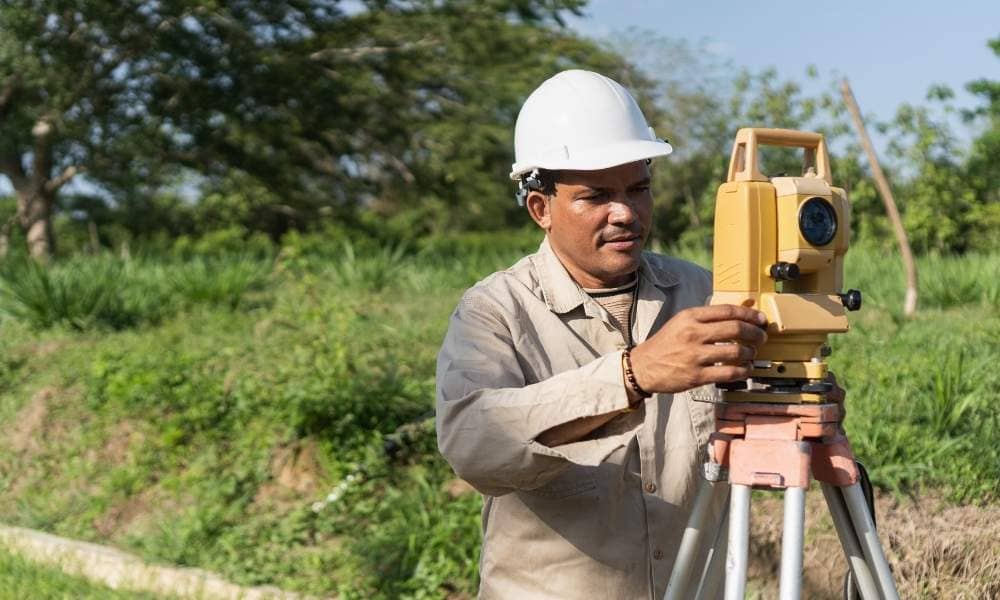
A land survey is how professionals measure and map your property. The survey process involves six simple steps. It takes about two to four weeks total. Each step is important. They all work together to create an accurate map of your property boundaries.
Overview of the Survey Process
A surveyor is a professional who measures land carefully and accurately. They use special tools and follow step-by-step procedures. The whole process takes about two to four weeks.
Here are the six steps:
- Research (3-5 days)
- Site visit (1 day)
- Measuring on your land (1-3 days)
- Working with the data (5-10 days)
- Making the map (5-10 days)
- Giving you the finished map (1 day)
Step 1: The Research Phase
Before measuring your property, the surveyor does important research.
The surveyor reads your property deed. This is a document that shows you own the land. They look at old survey records and government documents from the county. They study descriptions of your property that mention old landmarks or markers.
The surveyor also looks at how your property relates to neighboring properties. They try to find where previous surveyors placed boundary markers. This research phase takes about three to five days.
Some properties take longer to research because their history is complex. This is normal and shows the surveyor is being careful.
Step 2: Initial Site Inspection
The surveyor visits your property to see what is there.
The surveyor walks around your property and looks for markers. A marker is something placed on the ground to show a property corner. Markers can be metal pins, concrete blocks, or even old trees mentioned in old documents.
The surveyor also notes any challenges. Maybe there are trees, rocks, or water features in the way. They look for steep hills or difficult ground. They figure out the best place to set up equipment for measuring.
This visit takes about one day. The surveyor is planning how to do the measuring work.
Step 3: Fieldwork and Measurements
Now the surveyor measures your property.
The surveyor brings special equipment like GPS devices and measuring tools. They set up at different spots on your property. They measure the distance from one point to another using precise tools.
The surveyor also notes everything on your land. Where are the buildings? Where are the fences? Are there trees, water, or other features? They write down everything they measure.
The surveyor also checks for things that cross property lines. If a fence or structure is on the neighbor’s land, they note it. They document any areas where neighbors have rights to use your land. This is called an easement. It means someone else has permission to use a part of your property, like for utility pipes or roads.
This measuring work takes one to three days. On Oahu and busy areas, it goes faster. On other islands or hard-to-reach properties, it takes longer.
Step 4: Data Processing and Analysis
After measuring, the surveyor works with all the numbers they collected.
The surveyor uses a computer program to organize the measurements. They make sure all the numbers make sense together. If something does not match, they look into why.
Think of it like checking your math homework. You collect all the numbers. Then you check them to make sure they are correct. The surveyor does the same thing with property measurements.
This step takes five to ten days. During this time, the surveyor makes sure everything is accurate before creating your final map. If something seems wrong, the surveyor might contact you to ask questions.
Step 5: Creating Your Survey Map
Now the surveyor creates your official map, called a plat.
The surveyor or a skilled drafter draws the map. It shows your property boundaries with exact measurements in feet. The map includes a legend that explains all the symbols used. It also shows the surveyor’s signature confirming the work is accurate.
Your survey map shows many things. You can see where property corners are. You can see the distance between corners. You can see buildings, fences, trees, and water on your land. You can see areas where neighbors have rights to use your land.
Before you get the map, another surveyor checks it carefully. They make sure there are no mistakes. This quality check is important. It takes five to ten days to complete and check the map.
Step 6: Delivery and Interpretation
The surveyor gives you your completed map and documents.
You get official copies of your survey map. You also get a document explaining what was found. The surveyor can explain what the map shows. You can ask questions about your property boundaries.
Keep your original survey in a safe place. You might need it someday. You could need it when applying for building permits. You might need it when selling your property. You could need it if there is a question about your boundaries. Many people keep their survey in a safe deposit box.
If you need extra copies later, you can ask the surveyor for more. You can also get copies from the county records office. Digital copies are easy to store and share with others.
The Survey Process in Hawaii
Surveys in Hawaii follow the same six steps as other places. But Hawaii has some unique conditions.
Hawaii has volcanic terrain. The ground can be rocky and hard to measure. Measuring land on rough lava fields takes more time than measuring flat areas. Some properties sit on steep hills. These are harder to survey than flat land.
Hawaii also has old property records. Some information comes from the Hawaiian Kingdom. Sometimes old documents have conflicting information. This means surveyors need more research time. It is normal and shows they are being thorough.
All surveyors in Hawaii must have a license from the state government. The Hawaii Department of Commerce and Consumer Affairs gives these licenses. Only licensed surveyors can do official survey work.
Properties with complicated history or difficult land might take thirty to thirty-five days instead of twenty-eight days. This extra time is expected and necessary.